
Can I manage an AEO plan on my own?

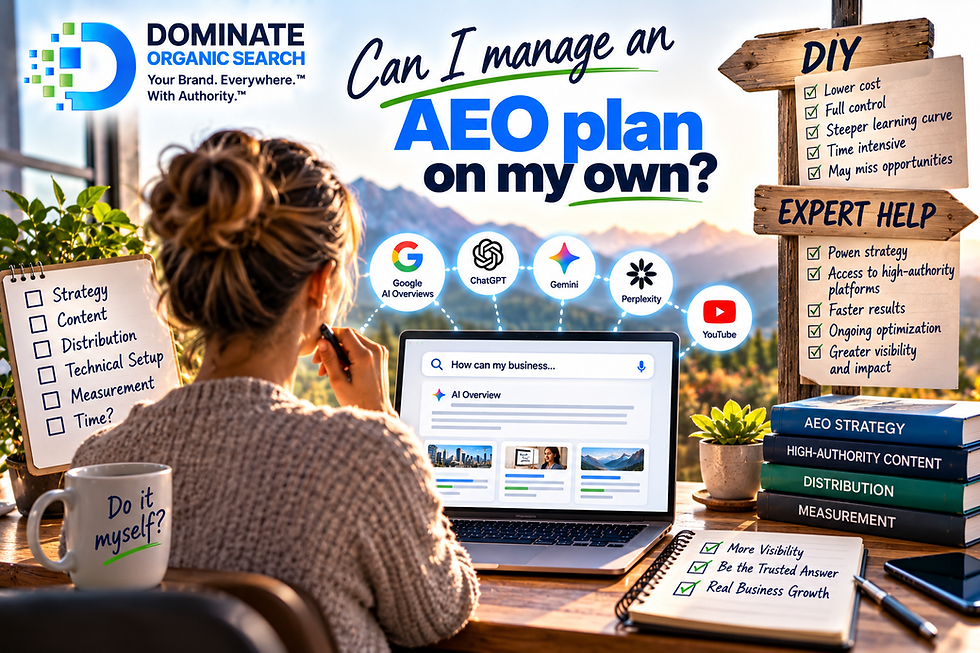
Chasing citations in ChatGPT or AI Overviews sounds simple until you hit five technical pillars, quarterly audits, and analytics tools that traditional SEO never taught you. Can a solo business owner really pull this off without help?
Key Takeaways
Managing an AEO plan alone means mastering five technical pillars at once, including schema engineering, entity optimization, and citation tracking - a challenge covered in detail below
AEO agency pricing in 2026 can range widely per month depending on scope and complexity, while an in-house Digital PR Manager or Digital PR Specialist salary adds another substantial ongoing cost to consider
AEO results can start appearing within a few days, but significant traction typically takes 2 to 4 months, with consistent visibility across multiple AI platforms and measurable business impact generally taking 3 to 6 months
Traditional SEO dashboards do not reveal whether a brand is being cited inside AI Overviews or other AI-generated results, creating a measurement blind spot that trips up many DIY efforts
Businesses treating AEO as its own discipline, rather than an SEO afterthought, see stronger results
Answer Engine Optimization, or AEO, is becoming a frontier for businesses that want to show up when customers ask AI tools like ChatGPT, Google's AI Overviews, or Perplexity a question. Instead of ranking for a search term, the goal is to become the actual answer an AI system gives.
That shift sounds simple, but the mechanics behind it are anything but.
What AEO Really Demands
AEO is a strategy for structuring website content so that search engines and AI systems can easily interpret, summarize, and present information as a direct answer to a user's question. Content has to be written and organized so machines, not just humans, can quickly digest it and trust it enough to repeat it.
This is where many small and medium business owners hit a wall. Building content that ranks well in traditional Google search results is one skill set. Building content that gets pulled into an AI-generated answer, cited by name, and trusted enough to be repeated across multiple platforms is a different challenge entirely. Businesses succeeding at AEO are the ones treating it as its own discipline rather than an SEO afterthought.
The technical requirements stack up fast. Structured data, entity relationships, citation tracking, and answer formatting all have to work together, and each one requires a different kind of expertise. Learning all of it while also running daily business operations is a tall order for any owner.
The Skills Gap Behind AEO
AEO requires specialized skills that most marketing teams simply do not have on hand. Entity optimization, schema engineering, platform-specific AI strategies, and citation tracking across multiple AI systems each demand their own learning curve. A business owner without a technical background can spend weeks just figuring out where to start.
AEO also calls for broader collaboration than traditional SEO ever did. It touches content marketing, web development, paid search, social media, public relations, and brand marketing all at once. Coordinating that many moving parts without a dedicated team is difficult, even for owners comfortable with marketing basics.
Five Pillars You Must Master
Optimizing for AEO rests on five key pillars, and missing even one weakens the whole plan:
Entity optimization - making sure AI systems clearly understand who the business is, what it offers, and how it relates to other trusted entities online.
Content architecture - structuring pages so information is easy for machines to extract and summarize accurately.
Citation authority - building the kind of trust and reputation that gets a brand mentioned and quoted by AI systems.
Technical foundation - the coding and markup work that supports everything else.
Measurement - tracking whether any of it is actually working.
Each pillar depends on the others. Strong content architecture means little without citation authority backing it up, and neither matters much if the technical foundation is missing.
Structured Data & Schema Hurdles
One common AEO challenge business owners run into is a lack of structured data and schema markup. This code helps AI-powered engines understand what a page is actually about, separate from the plain text a human reader sees. Without it, even well-written content can get overlooked by AI systems scanning for reliable answers.
Setting up schema correctly involves technical coding knowledge that exceeds the capabilities of most website builders or basic plugins. Mistakes in this markup can quietly undermine months of content work, and they're often invisible unless someone knows exactly what to check.
Content Formatting for AI Answers
Poor content structure and answer formatting create another common stumbling block. AI systems favor content that answers questions directly and clearly, often in the first few sentences of a section. Content that talks around a topic instead of answering it plainly keeps otherwise solid pages from ever being pulled into an AI response.
Writing this way takes practice. It means restructuring how information gets presented, leading with the answer rather than building up to it the way traditional blog writing often does.
Why AEO Never Stops
AEO strategies require ongoing attention rather than a one-time project. Unlike a website redesign or a single content push, AEO needs a consistent publishing and update rhythm to keep working. AI systems continuously reassess which sources deserve to be cited, and content that goes stale quickly loses its place.
Quarterly Audits & Constant Updates
Part of that ongoing work includes scheduling quarterly content audits to refresh statistics, update broken or outdated links, and re-check that structured data still matches current page content. Skipping these check-ins allows small errors to pile up, gradually eroding the trust AI systems place in a site.
Timelines: 2-4 Months to Traction, Longer for Deep Authority
Patience matters here. AEO results can start appearing in as little as a few days, but most businesses should expect 2 to 4 months before seeing significant traction, depending on competition, search volume, and algorithm shifts. Consistent visibility across multiple AI platforms generally takes 3 to 6 months, with measurable business impact landing in that same window, since AI systems need time to build confidence before consistently recommending a source. Business owners hoping for overnight results often give up before the strategy has a chance to compound.
Measuring What SEO Tools Miss
AEO performance cannot be tracked with the same analytics infrastructure built for traditional SEO. Rankings and organic session counts, the bread and butter of most SEO dashboards, do not reveal whether a brand is actually being cited inside AI Overviews or other AI-generated search results. This creates a measurement blind spot that trips up even experienced marketers.
Beyond Citations: Coverage, Quality & Impact
New measurement capabilities are a requirement for managing AEO well, not an optional add-on. Tracking share of answer engine voice, citation rate, and brand sentiment within AI responses calls for tools and processes most small businesses have never used before. Without this visibility, it becomes nearly impossible to know whether an AEO plan is working or quietly failing.
The Real Cost of Doing It Alone
Cost is often the deciding factor for business owners weighing whether to manage AEO in-house. AEO agency pricing in 2026 varies widely per month depending on the scope of work and the complexity of the account, from smaller starter engagements up to full-execution retainers for larger, more competitive brands. Hiring an in-house technical strategist is another path: annual pay for a Digital PR Manager in the United States varies by experience and location, while a Digital PR Specialist commands a comparable salary. Neither figure includes payroll taxes, software subscriptions, or benefits.
Speed and Range vs. Control and Long-Run Cost
Weighing the DIY route against outside help comes down to a few honest trade-offs:
Going it alone offers full control over timing and messaging, but demands the owner personally master five technical pillars while running the rest of the business.
Hiring in-house staff builds dedicated expertise, but the salary commitment lands well above what most small businesses budget for a single marketing function.
Working with an outside team provides speed and range across formats and platforms immediately, without the ramp-up time of training someone new.
What Professional Management Unlocks
Professional AEO management can position a brand as an authoritative leader in its industry, leading to deeper trust when AI models consistently cite its content. That kind of consistent citation signals to both AI systems and human readers that a business is a dependable source of information.
Authority, Trust & Higher Conversions
AEO services can increase conversion rates by directing highly qualified leads to a site straight from AI sources, since AI engines pull precise data to solve specific problems a user already has in mind. Traffic that arrives this way tends to convert faster because the AI answer has already done part of the explaining and positioning work before the visitor ever clicks through.
Visibility Even Without Clicks
AEO also builds visibility without relying on clicks at all. Being selected as "the answer" inside an AI response works like a trust endorsement, keeping a brand visible in zero-click search results where a traditional website link might never appear. As more searches shift toward AI-driven answers, this kind of visibility protects a business from becoming invisible as the search environment keeps changing.
The Verdict on Going It Alone
Managing an AEO plan alone is technically possible, but the combination of specialized skills, ongoing upkeep, and unfamiliar measurement tools makes it a heavy lift for most small and medium business owners. The five pillars alone represent years of accumulated expertise in schema engineering, content architecture, and citation building, and none of that expertise stays static as AI platforms keep evolving.
Business owners weighing their options should be honest about their available time and technical comfort level before committing to either path. For those ready to consider what a structured, professionally managed approach looks like, Dominate Organic Search provides a practical next step toward building lasting authority in AI-driven search.


Comments