
Why keywords aren't working anymore.

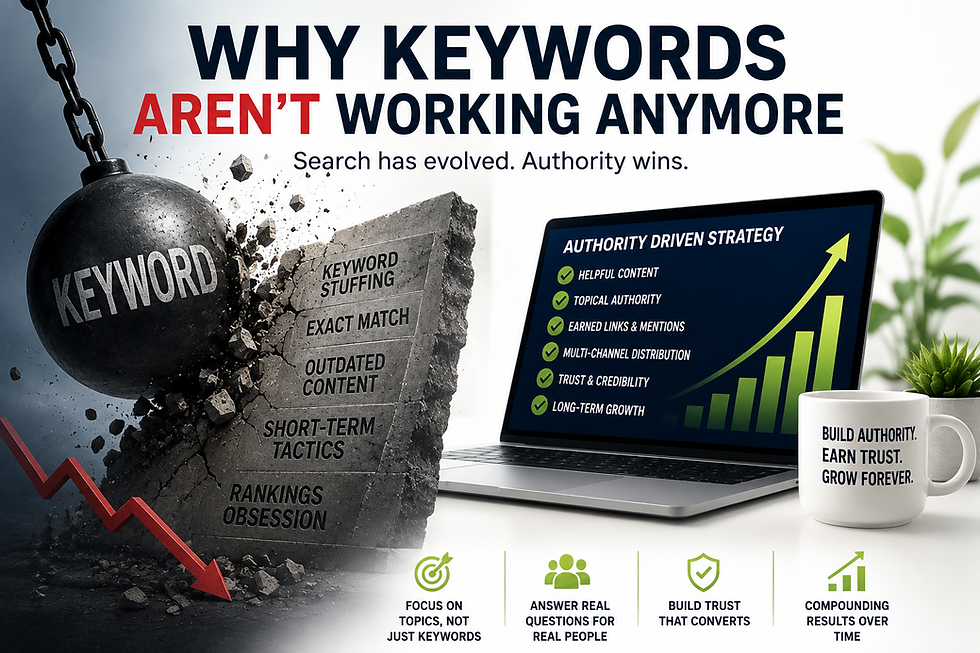
Key Takeaways
Keywords haven't disappeared from SEO - but using them in isolation is no longer enough to drive meaningful organic traffic.
Google's algorithms now read meaning and context, not just word matches, making user intent the real ranking signal.
AI Overviews are absorbing clicks that used to go to organic results, especially for informational searches.
Building topical authority and publishing across multiple channels compounds visibility over time - something simple keyword targeting never could achieve.
The businesses winning organic search today are earning trust at scale, not gaming word counts.
If a strategy that used to work reliably has quietly stopped delivering, it's worth asking why. The answer isn't complicated - but it does require a real shift in how organic search gets approached.
Keywords Alone No Longer Move the Needle
There was a time when placing the right keyword in the right spots - title, headers, body copy - was enough to earn a solid ranking. That era is over. Keywords still matter, but their role has fundamentally changed: they now serve as signals that guide content strategy, not formulas that guarantee visibility.
The problem with keyword-only thinking is that it treats search like a filing system. Modern search engines don't file - they reason. Google's job is to match a person's actual need with the most helpful answer available. A page stuffed with a phrase but thin on genuine insight fails that test every time. What earns rankings now is content that demonstrates real expertise, addresses what people actually want, and builds credibility over time.
Dominate Organic Search (DominateOrganicSearch.com) frames this shift clearly: authority is the strategy. The businesses that dominate page one aren't the ones with the most keyword-optimized pages - they're the ones Google trusts most.
Google Stopped Counting Words, Started Reading Meaning
The mechanics behind this shift trace back to specific algorithm updates that changed what Google actually measures.
Hummingbird and BERT Changed Everything
Google's Hummingbird update (2013) was the first major move away from keyword matching toward understanding full queries as a whole. Rather than parsing individual words, Hummingbird evaluated the intent behind a search phrase. Then came BERT (2019), a deep learning model that gave Google near-human-level comprehension of natural language - including how word order, prepositions, and context change meaning entirely.
The practical consequence: keyword stuffing stopped working, and pages that addressed a topic thoroughly - in natural, readable language - started outranking those that merely repeated a phrase.
Context and Natural Language Now Drive Relevance
Today, Google evaluates content the way a knowledgeable human editor would. It asks: Does this page actually help someone? Does it cover related concepts? Is the author credible? Does the content match what the searcher is trying to accomplish? Relevance is now a multi-dimensional score - not a word count.
AI Overviews Are Eating Your Clicks
Even well-ranked content is losing traffic. Google's AI Overviews now appear at the very top of results for a wide range of queries, pulling key answers directly into the search page. The user gets what they need without ever clicking through.
Informational Keywords Hit Hardest
Research confirms that AI Overviews are significantly reducing click-through rates for informational keywords - the "what is," "how to," and "why does" queries that marketers have historically built content strategies around. If the entire value of a page is answering a simple question, Google's AI can now answer it without sending anyone to the site.
This doesn't mean informational content is worthless. The bar has simply risen. Content needs to go deeper, offer original perspective, or build enough brand authority that readers actively seek out the source - not just the answer.
User Intent Outranks Keyword Match
Understanding what someone searched is only half the equation. Understanding why they searched it is what separates content that ranks from content that converts.
What Your Audience Is Really Researching
User intent - the underlying goal behind a search query - now drives how Google categorizes and ranks content. A search for "project management software" could come from someone comparing tools, someone already mid-trial looking for a feature explanation, or a manager trying to make a purchase decision this week. The same keyword, three completely different intents, three different content needs.
The most effective content strategies map audience research to the motivation behind the search, not just the words used. That means understanding pain points, questions, and objections at each stage of the decision process.
Aligning Content to the Buying Journey
An audience moving toward a purchase doesn't follow a straight line. They research broadly, compare options, look for social proof, and eventually need a clear reason to act. Content aligned to that journey - awareness pieces, comparison guides, case studies, trust-builders - outperforms any single keyword-optimized landing page because it meets people wherever they actually are.
Studies consistently show that the vast majority of people - over 80% across most research, with some studies reporting figures well above 90% - conduct online research before making a buying decision. That means the question isn't just "what keywords should we rank for" - it's "what does our audience need to see before they trust us enough to act?"
Authority Is the New Ranking Signal
I
f keywords are the old currency, authority is the new one. Unlike keywords, authority can't be faked with formatting tricks.
Topical Depth Over Keyword Volume
Topical authority means demonstrating genuine, deep expertise across a subject area - not just targeting isolated terms. A site that covers a topic from multiple angles, answers related questions, and connects concepts earns more trust from Google's systems than a site with one optimized page per keyword.
AI-driven search engines now measure entity authority - whether a brand is recognized as a credible source for a concept, not just a string of words. That recognition builds through consistent, substantive content published over time.
E-E-A-T: Google's Trust Framework
Google's E-E-A-T framework - Experience, Expertise, Authoritativeness, and
Trustworthiness - is the clearest articulation of what modern rankings require. It rewards content that demonstrates first-hand knowledge, comes from credible authors, is supported by consistent subject focus, and is published transparently.
E-E-A-T isn't a checkbox. It's the cumulative signal of everything a brand publishes, where it's published, and who vouches for it. Earning it takes time - and a deliberate strategy.
Omni-Presence Publishing Fills the Gap
The answer to declining keyword effectiveness isn't to find better keywords. It's to build the kind of brand presence that makes keyword dependency irrelevant.
One Idea, Six Formats, Hundreds of Platforms
A single content idea - one topic your audience genuinely cares about - can be transformed into a news article, blog post, video, infographic, slideshow, and audio ad. Each format reaches a different segment of the audience across different platforms.
That same idea then lives on YouTube, Spotify, Apple Podcasts, Pinterest, Business Insider, and dozens of news networks simultaneously.
This isn't content volume for its own sake. It's strategic saturation - getting your brand in front of the right audience across every channel they already use, reinforcing authority with every touchpoint.
How Multi-Channel Content Drives Measurable Growth
The results speak for themselves. A European CRM company that shifted to a multi-channel content strategy spanning search, social, email, and media saw organic traffic grow by 97% and organic leads increase by 43%. Neither result came from finding a magic keyword. Both came from consistent, strategic publishing that built authority over time and showed up everywhere the audience was looking.
Authority Compounds - Keyword Tricks Don't
Here's what makes authority-driven SEO different from every short-term tactic: it compounds. Each piece of content published on a high-authority platform adds another signal. Each format distributed across another channel widens the footprint. Each month of consistent visibility makes the next month easier.
Keyword tricks, by contrast, have a ceiling. They require constant updating as algorithms shift, they get copied immediately by competitors, and they do nothing to build the underlying trust that converts visitors into buyers.
The brands that will own organic search over the next five years aren't the ones chasing rankings - they're the ones building authority so strong that Google has no choice but to surface them. That's not a campaign. It's a system.
For growth-focused marketing teams ready to make that shift, Dominate Organic Search builds and manages exactly that kind of authority-driven, multi-channel visibility system - handling strategy, content, and distribution so the focus stays on running the business.


Comments