
What is GEO?

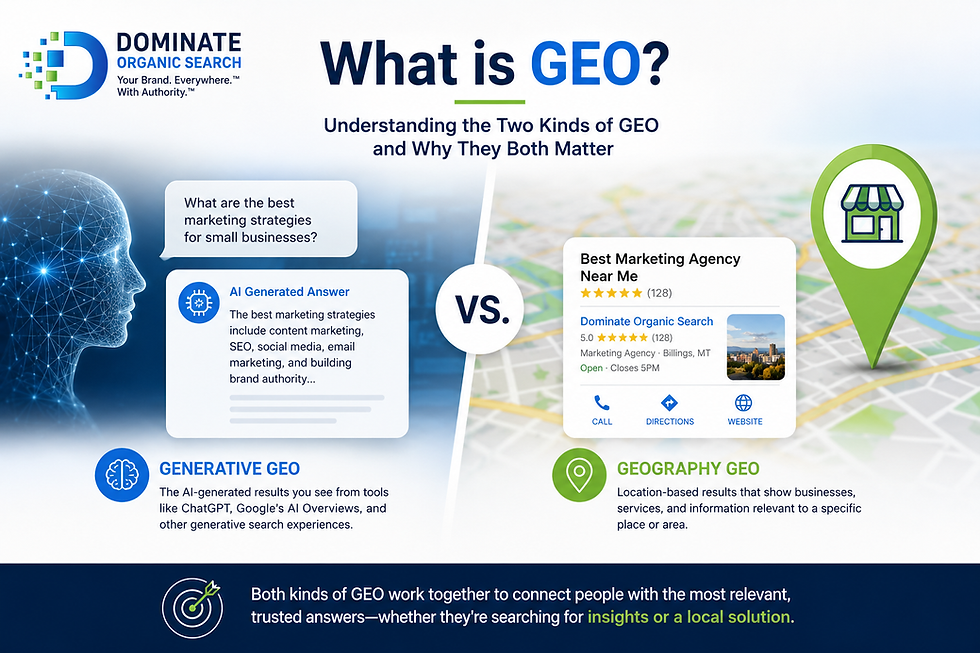
GEO means two different things right now, and confusing them could cost your business visibility. Nearly 14% of searches already trigger AI Overviews - so is your content built to get cited, or just ranked?
Key Takeaways
GEO stands for two related ideas: Generative Engine Optimization, which helps content show up in AI-generated answers, and Geographic Engine Optimization, which helps local businesses show up in nearby searches
AI chatbots and AI Overviews are changing how people search, so relying only on traditional search engine rankings leaves gaps in visibility
A well-built Google Business Profile and content that directly answers common questions are two of the strongest tools for earning AI citations
Businesses that want a done-for-you approach to building visibility across trusted platforms can look to Dominate Organic Search for guidance
This piece breaks down practical steps for showing up in both AI answers and local map searches, so a business can see which strategy fits its goals best
Search is changing shape, and the term GEO has popped up to describe two different but related shifts happening at once. Some use it to mean Generative Engine Optimization, the practice of getting content noticed by AI tools like ChatGPT and Google's AI Overviews. Others use the same three letters for Geographic Engine Optimization, which is about showing up when someone nearby searches for a product or service. Both matter for small and medium business owners trying to stay visible, and understanding the difference is the first step toward building a smarter marketing plan. Dominate Organic Search has watched this shift play out across client campaigns and treats it as a natural next chapter of organic visibility rather than a replacement for what came before.
AI Search Is Rising, Not Replacing Search Yet
Traditional search engines are not disappearing anytime soon, but the way people use them is shifting. Reports on AI chatbot usage have shown mixed patterns recently, with some measures of heavy daily use pulling back even as a growing share of active AI users say they now start their searches with an AI tool instead of a traditional search engine.
Analysts have also predicted that traditional search engine volume will decline over time as more users turn to AI chatbots and virtual agents for answers.
That said, Google, Bing, and other traditional search engines still handle the majority of daily searches. AI Overviews and chatbot answers often pull directly from top-ranking web pages, which means strong traditional SEO remains the foundation that generative visibility builds on top of. Businesses that ignore one channel while chasing the other risk losing ground on both fronts.
GEO vs. Traditional SEO
Traditional SEO focuses on ranking a webpage as high as possible on a results page full of blue links. It rewards keyword targeting, backlinks, page speed, and technical structure so a business shows up when someone scrolls through search results.
Generative Engine Optimization takes a different angle. Instead of aiming for a ranked spot on a list, GEO aims to get content cited, quoted, or summarized inside an AI-generated answer. A user asking an AI assistant "What's the best HVAC company near me?" never sees a list of ten links; they see one direct answer, and the goal of GEO is making sure a business's information is part of that answer. The two approaches share some common ground, like the value of clear, well-organized content, but they measure success differently: one counts clicks and rankings, the other counts mentions and citations.
Two Faces of GEO
Generative Engine Optimization
Generative Engine Optimization is the practice of shaping digital content so it gets picked up by AI-generated responses from tools like ChatGPT, Google's AI Overviews, Perplexity, and Gemini. It works by aligning content with how these large language models interpret information, structuring facts, questions, and answers so an AI system can quickly recognize the content as trustworthy and useful. This form of GEO is sometimes called AI Search Optimization, Conversational Search Optimization, or Large Language Model Optimization, depending on which corner of the industry is talking about it, but the goal stays the same: earning a spot inside the answer itself.
Geographic Engine Optimization
Geographic Engine Optimization takes a narrower, location-based focus. It blends local SEO, Google Business Profile optimization, and localized content strategies to help a business show up when someone searches "near me" or "in [city]." A bakery in Anthem, Arizona, benefits from this kind of GEO through ensuring its address, hours, and services are clearly listed everywhere a potential customer might look, from Google Maps to local directories. This flavor of GEO has existed for years under the "local SEO" umbrella, but the letters GEO increasingly get used to describe it too, especially as AI tools start pulling from the same local data sources.
Why This Shift Matters Now
AI Chatbots Are Changing How People Search
More people are turning to conversational tools as a first stop for research, whether they're comparing products, planning a trip, or looking for a nearby service provider. Many small businesses have already noticed this shift; a recent survey found that about half of them are actively monitoring the traffic and mentions coming from AI referrals. That kind of attention signals a real change in how visibility gets measured, moving beyond simple click counts toward tracking whether a brand gets named at all inside an AI-generated answer.
AI Overviews Are Reshaping Local Search
AI Overviews are appearing more often, even for searches with a clear local intent. Research from Uberall found that by late 2024, AI overviews were already appearing in close to 14% of all search results, including local ones. That means a business could be doing everything right for a traditional map listing and still miss out on visibility if its information isn't structured in a way that AI systems trust enough to cite. Local businesses in particular need to pay attention here, since these AI-driven summaries can change which company gets recommended when a nearby customer needs a service.
Building Content AI Engines Trust
Your Google Business Profile Is What AI Cites
A complete, accurate Google Business Profile has become one of the most reliable sources AI systems pull from when answering local questions. Hours, services, photos, categories, and especially reviews all feed into how confidently an AI tool recommends a business. Skipping profile updates or leaving fields blank creates gaps that AI systems either fill with outdated information or skip over entirely in favor of a competitor with a fuller listing.
Answering Questions Directly Earns AI Citations
Content that answers a real question in plain, direct language earns citations far more often than content buried in vague marketing language. A page that opens with "What does a solar panel installation cost in Phoenix?" followed by a clear, specific answer gives an AI system exactly the kind of structured information it looks for when building a response. A few habits make a noticeable difference:
Lead with the direct answer before adding supporting detail, mirroring how a person would explain it out loud.
Use headings phrased as real questions, since AI tools frequently match a searcher's question to a matching heading.
Keep reviews current and encourage detailed feedback, since AI Overviews frequently pull language straight from recent reviews.
Update service pages regularly so pricing, hours, and offerings never fall out of sync with what's live elsewhere online.
Ranking and Being Cited Now Both Matter
Generative visibility and traditional ranking now function as two halves of the same marketing strategy. A business that only optimizes for classic search results risks becoming invisible inside the growing wave of AI-generated answers, while a business that only chases AI citations without a solid website foundation has nothing solid for those AI tools to pull from in the first place. The strongest approach treats both goals as parts of the same system: clear, well-structured, regularly updated content that works whether a human is scrolling through search results or an AI assistant is summarizing an answer out loud.
Building that kind of content and distribution system takes consistent effort, which is exactly the gap a done-for-you publishing approach is designed to fill for business owners who don't have the in-house time or team for it. For a practical next step, local search visibility strategies can show how a business starts showing up in both traditional rankings and the AI-generated answers customers increasingly rely on.


Comments